
What does Op Art mean?
Let's find out what Op Art really is!

Today, we’re going to discover how dizzy can we get while learning Op Art.
We’ll learn important things about the world of Op Art like:
What is Op Art?
What is cool, interesting, and important about Op Art?
Op Art characteristics?
Who created Op Art?
Famous artists from this time and Era.
What is Op Art?
Op art is short for 'optical art'. An art movement that emerged in the 1960s.It is characterized by the use of optical illusions, geometric patterns, and precise arrangements of colors and shapes to create artworks that appear to vibrate, move, or deceive the viewer's perception.
Have you seen an optical Illusion before? Op Art works in a similar way. Artists use shapes, colours, and patterns in special ways to create images that look as if they are moving or blurring.
What cool, interesting, and important things about Op Art?
In the 1960s. The term 'Op Art' was coined in 1964 by Time magazine to describe work that relies on optical illusions. It has a strong relation to geometric design, originally produced mostly in black and white but later in vibrant color.
Why did artists create artworks like this? The Op art movement was driven by artists who were interested in investigating various perceptual effects. Some did so out of sheer enthusiasm for research and experiment, some with the distant hope that the effects they mastered might find a wide public and hence integrate modern art into society in new ways.
The main goal of Op art is essentially based on the principle of optical illusion: far from representation, Op Art does not aim to depict but create an illusion. The play with geometric forms and colours can be so convoluted and sophisticated that looking at a piece of Op Art can be dizzying.
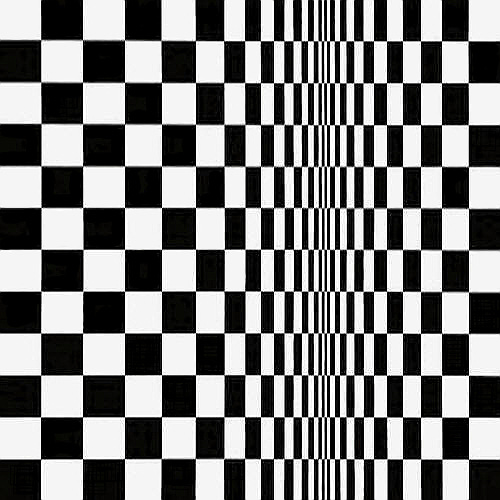
What does it feel like when you look at Op Art?
The effects created by op art ranged from the subtle to the disturbing and disorienting. Op painting used a framework of purely geometric forms as the basis for its effects and also drew on colour theory and the physiology and psychology of perception.
I just feel really dizzy after looking at this so not a big fan lol.
What makes a good Op Art design?
Distorting the viewer's perception of motion, depth and form by emphasising discordant figure-ground relationships, the most iconic examples of Op Art rely on high-contrast black-and-white lines and patterns, composed with mathematical precision.
Did you know according to experts, optical illusions help you to make your brain sharper. They make you think hard about how a certain thing is possible, lead you to understand the working of a human brain, and how interesting it is. It also actually helps understanding the difference between 'looking' and 'seeing'.
That's pretty cool, so lets all get dizzy and exercise our brains by looking at these Optical art.
Characteristics of Op Art.
The 3 main Characteristics of Op Art are:
Abstract patterns are composed with a stark contrast of foreground and background.
Often in black and white for maximum contrast
To produce effects that confuse and excite the eye.
Is Op Art only black and white?
It's a yes and no.
A lot of Op Art features geometric shapes and lines in black and white or vivid colors. Op art is done in black and white only and also using certain color combinations because of their relationship to one another produces a certain effect on the eye. These color relationships are simultaneous contrast, successive contrast, and reverse contrast (or assimilation).
Now you must be wondering, What's the difference between Pop art and Op Art? Sounds quite similar.
Unlike Pop art which drew on imagery from popular culture, however, Op art was a style of abstraction that relied on geometric shapes, lines, and color juxtapositions to create optical illusions for the viewer.
They are 2 very different things!
Who created Op Art?
A French-Hungarian artist called Victor Vasarely is best known for his prominent role in establishing the art movement known as Op Art, or Optical Art. He is often referred to as the 'grandfather' of Op Art.
Famous Artists of the Op Art period
Now let’s take a look at some of the most well-known artists in the Op Art period!
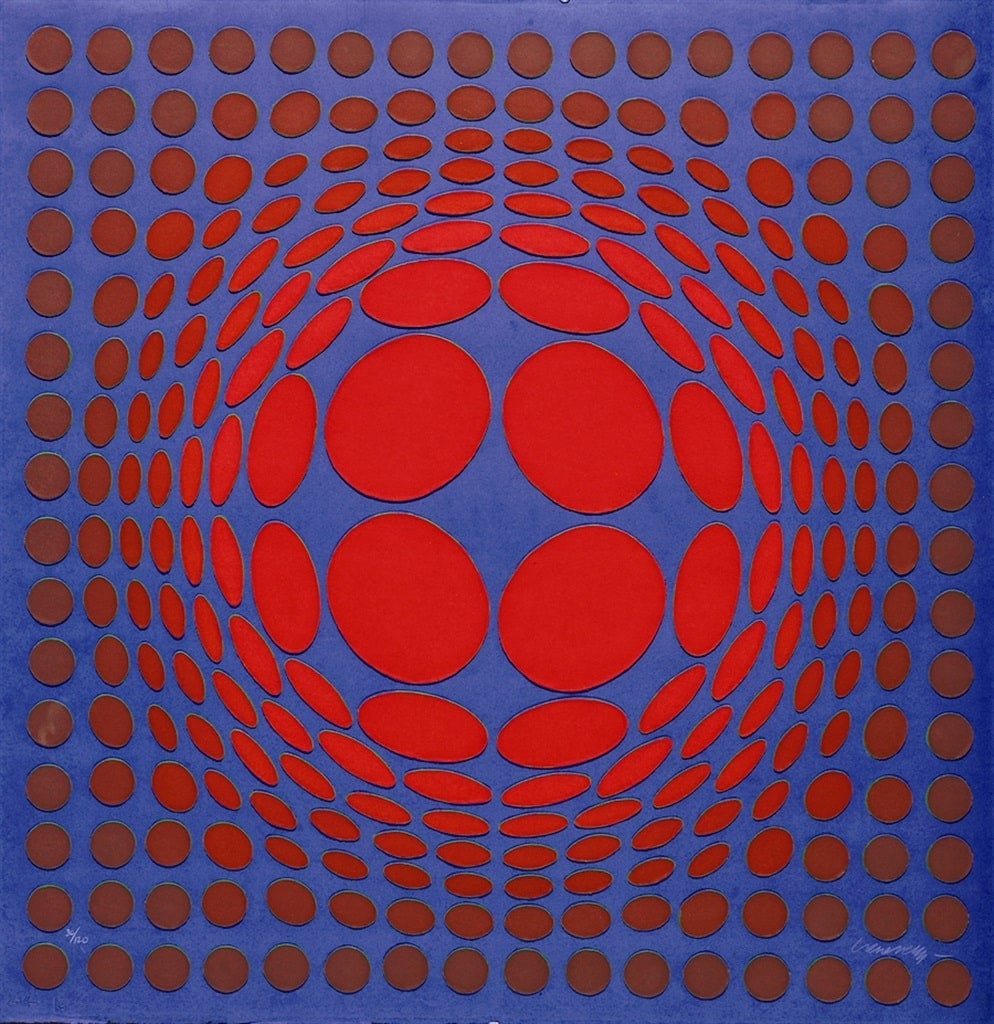
Victor Vasarely (1906-1997) He is best known for his grid-like paintings and sculptures of the 1960s onwards, which play with the reader's sense of visual form by creating illusory, flickering effects of depth, perspective, and motion.
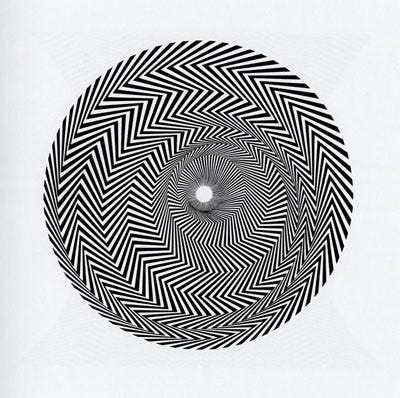
Bridget Riley (April 24, 1931) Riley became an icon, not just of Op art, but of contemporary British painting in the 1960s, and she was the first woman to win the painting prize at the Venice Biennale in 1968. Riley's innovations in art inspired a generation of Op artists.
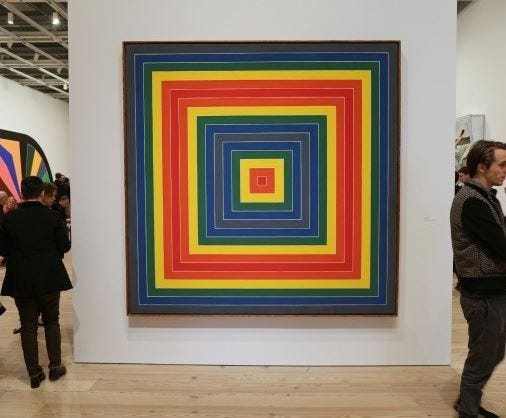
Frank Stella (1936-2024) Stella's method of working systematically in a series emphasized his problem-solving approach to painting. He arranged flat color fields into repetitive, geometric patterns and created all-over, non-illusionistic surfaces. His logic, control, and extreme reductionism prefigured minimalism.
Carlos Cruz-Diez (1923-2019) Carlos is an artist and color theorist. He has been widely recognized as one of the most representative figures of the kinetic art movement, which took hold in Europe in the mid-20th century.
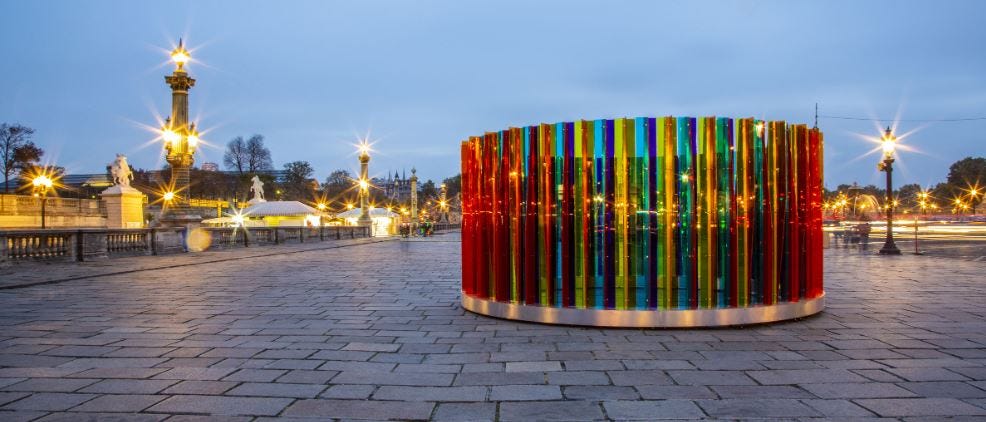
Jesús Rafael Soto (1923-2005) His work is often associated with Venezuelan Op art because the serial geometric forms of his paintings of the 1950s bear an affinity to works from that later movement. By 1957 Soto had moved toward a more gestural abstraction, but by 1965 he had returned definitively to a geometric idiom.
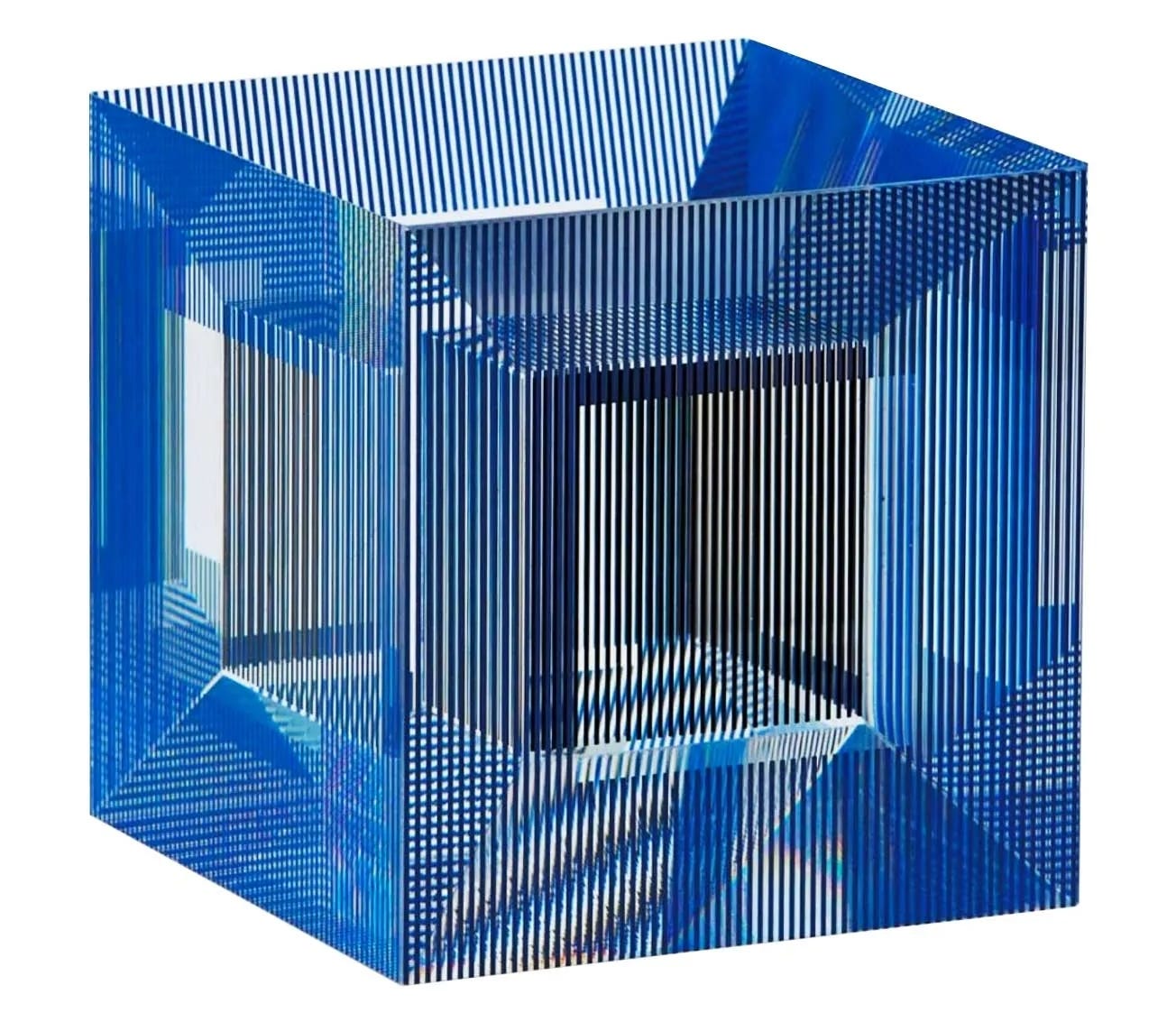
Mini Exercise for you!
This week, I want you to explore more on your own and see what else you can discover about the world of Op Art. See if you can learn more and explore some of your new favorite artists from this time and art movement.
Have fun learning and exploring!
What did you discover?
I’m curious to see what you discover about Op Art. If you also discovered something new about it, I would love to know! (You can comment and share your thoughts below!)
Thank you for reading my fun little discovery and I hope you also get to learn and share your discoveries too!
Share this with fellow friends, family, and artists who would benefit and love learning more about art! On social media, email, or text. Thanks for reading!
Check out this YouTube video if you love this art article about Abstract Expressionism. Sharing thoughts and ideas! If you like it, please like and subscribe to my YouTube channel for more videos like these!